Carrying on with the Marmit World of Tropical Fish collection, that is one other of the cichlid figures, one even much less widespread as a determine, quantity 9 within the collection. It is a widespread African cichlid species, generally known as the electrical blue hap, Sciaenochromis fryeri. The widespread identify ‘hap’ refers back to the unique genus identify Haplochromis, which was one thing of a wastebasket taxon for a lot of cichlids of the East African rift area, at one time making it probably the most species-rich genus of fish. Much less so now, not solely resulting from taxonomy, but additionally overfishing and impacts by launched Nile perch and Nile tilapia.

There are nonetheless a variety of Haplochromis species after all, however the electrical blue hap is one among 4 species that was separated out into Sciaenochromis. All of them look type of related, however I’ve the paper and was capable of translate the textual content. It really gave the precise genus/species so not a variety of ambiguity there, though a associated species, S. ahli, was initially bought below the identify electrical blue hap. They’re rarer although, and bigger. I did preserve some Malawi cichlids again within the day and should have even stored the electrical blue haps (alongside another species), however they normally arrived as ‘African cichlid varieties’ and I didn’t know the entire species. It was nonetheless simply companions for my bichirs!

Of the 4 species, S. fryeri is probably the most often seen in captivity, so it is smart because the determine within the set. This species is endemic to Lake Malawi, discovered alongside rocky coastal margins at modest depths. Lake Malawi is after all notable for its tons of of cichlid species, nearly all of that are endemic. This species is pretty small, about 11.5 cm (4.5 inches) lengthy, although different species might be bigger. They’re piscivores, primarily searching the fry of different cichlids among the many rocks. The species can also be sexually dimorphic, with the attribute vibrant blue color solely present in males.

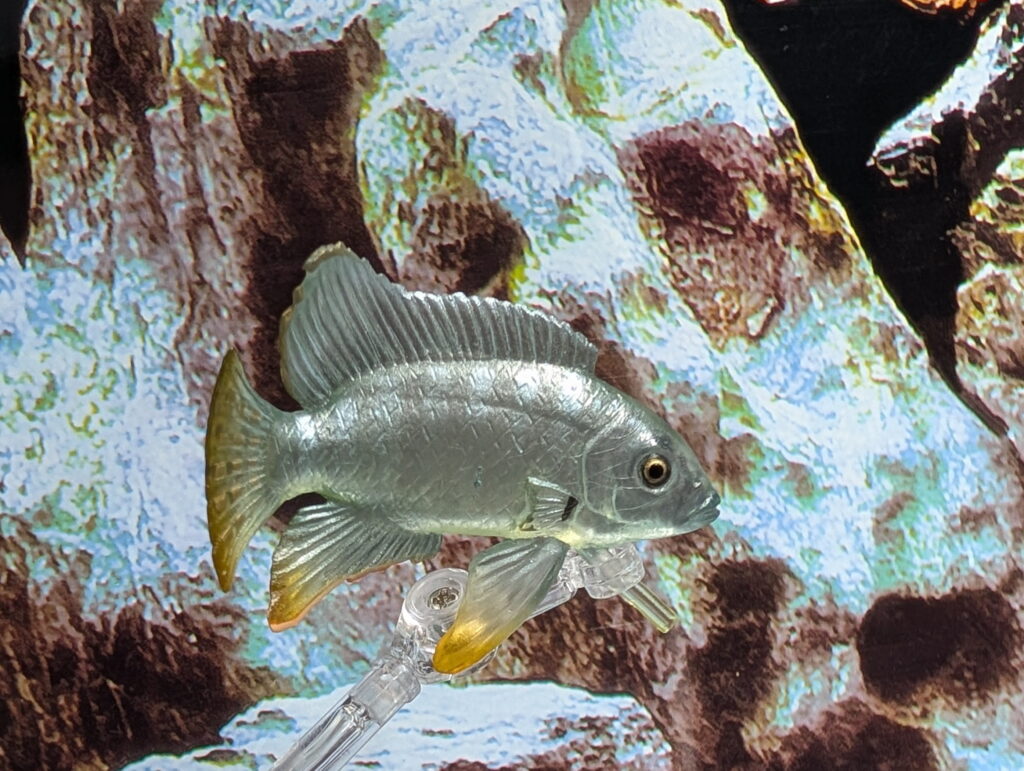
The determine itself is 6cm (2.4 inches) lengthy, giving a scale of about 1:2 for a full-grown grownup S. fryeri (1:4 for S. ahli should you’re curious). In hand it seems like in regards to the measurement I’d usually obtain and promote them at once I labored at fish retailers. The fish total has a really daring look, with all fins prolonged out, and a slight proper curve on the posterior, with the trailing fringe of the anal and dorsal fins following the bend and curve of the caudal peduncle and tail. The peg and base has the fish oriented in order that it’s face down, with tail larger up, probably indicating that it’s searching among the many rocks. After all, the entire Marmit bases are the identical, in order that’s simply conjecture.

The physique is elongate and laterally compressed, with a rounded again and extra linear stomach. The top is generally clean aside from the cheeks and opercula, in addition to tiny nostrils in entrance of the massive, recessed eyes. The mouth is closed with distinct lips. Behind the gills, the pectoral fins are small and wedge-shaped, sculpted towards the physique. The physique itself is roofed in shallow, diamond-shaped scales that seem uniform in measurement. There’s a shallow, distinct horizontal groove about one third down from the again meant to be the lateral line.

The remainder of the fins are giant and prolonged. The only dorsal fin begins with the entrance two thirds being low with thick spiny rays, whereas the again third rises up and again to a degree, with thinner rays. The posterior margin is considerably irregular. The anal fin extends from roughly reverse the upper a part of the dorsal fin, brief and squared on the entrance, extending longer and pointed on the again, effectively past the bottom of the anal fin. The caudal fin is squared and truncate, and just like the anal fin has quite a few distinct fin rays.

The pelvic fins prolong perpendicular to the physique, beneath the pectoral fins, in an extended scythe-shape. The rays on these fins are thicker, and there are fewer of them. Curiously, the 2 pelvic fins are sculpted in order that they’re one piece, with an indentation throughout to separate them. If I needed to guess, this can be a selection for improved manufacturing. The bottom of the pectorals is small, and there might have been points with breakage in the event that they weren’t joined (there’s one different determine that has the identical state of affairs).

General, the sculpt is definitively an African Malawi cichlid. The form is unmistakable. That stated, the fins appear somewhat in depth for what we’d usually see in an electrical blue hap. The dorsal fin particularly extends what appears to be far larger than regular, and the trailing fringe of each the dorsal and anal fins appear to be they go somewhat too far again; the anal fin on the determine nearly reaches the outer fringe of the caudal fin, when it ought to cease about midway. However possibly it was primarily based on captive bred morphs or one thing?

The color on the fish is truthfully somewhat underwhelming given the identify ‘electric’ blue hap, however it’s a minimum of blue. If I needed to guess, this is perhaps a consequence of the way in which a lot of the figures are colored—as talked about with the blue discus earlier than, the determine itself is solid in a translucent plastic which provides an attention-grabbing look however I believe was additionally meant to avoid wasting productions effort (this will probably be seen on nearly all later figures, however I did miss that it’s true however much less apparent on the yellow tail arowana). The plastic itself is the sunshine, shiny blue. It could have a metallic sheen or may simply be shiny. This color extends over the entire of the physique and fins, appearing as a base for additional highlights.


The darkest color is across the eyes, that are a darkish yellow with black central pupils. The bottom of the pectoral fins has a definite black band, which appears somewhat exaggerated from the actual animal. The dorsal fin is completely blue aside from some marginal yellow colouration on the posterior edge. The pelvic and anal fins are additionally principally blue, with yellow alongside the distal margins and factors. The margin of the anal fin is painted with a skinny, cream-coloured paint. This seems to be the one paint on any fins or the physique. The underside of the pelvic fins are yellow, and the trailing fringe of the anal fin is particularly yellow. The tail fades from blued on the peduncle to yellow on the furthest edge, with three radiating vertical bands of black spots. On the perimeters of the physique are seven faint gray vertical bands, beginning behind the opercula and ending on the caudal peduncle.

The unusual factor about this colouration is that it’s principally appropriate, however I believe the appliance might have weakened it a bit. A male electrical blue hap (an grownup breeding male a minimum of) ought to be darkish blue, and there ought to be scattered yellow alongside the perimeters of the anal, dorsal and tail fin. And there ought to be darkish bands. However as introduced, the entire colors are type of muted. Probably extra lifelike, truthfully, for day-to-day colouring, however I believe it’s affected by the entire color being a part of the plastic, even the yellow and the bands, versus painted onto the mannequin. Apart from the margin of the anal fin, solely the patch on the pectoral fin and the attention colouring seems to have been added later. Talking of the attention, I believe it’s too small relative to the top. In the event you’re questioning, Sciaenochromis ahli has just about the identical colouration as S. fryeri, so I don’t assume it’s confusion between widespread names and colouration.

Apart from these small digressions, I believe this is perhaps the nicest haplochromine cichlid determine produced that I’m conscious of. As a result of I believe it could actually be the one one among two definitively identifiable Malawi rift cichlid (the opposite comes from an organization that’s exhausting to search out, and I don’t all the time belief their naming). Given their outrageous varieties in color, shapes, sizes, behaviours, and species, to say nothing of their broad attraction and familiarity in just about any space the place fishkeeping is a passion, one would assume we’d see extra Malawi cichlids (and truthfully, cichlids basically) as toys and fashions. So, we ought to be blissful that this determine is definitely fairly first rate. It fits the total set effectively, representing widespread species throughout the passion, and is surprisingly not too exhausting to get even now, contemplating how way back it was launched. Future installments are going to go in far completely different instructions! However we’ll nonetheless get see cichlids once more.

 All articles on the Animal Toy Weblog are written with out using ‘AI’