
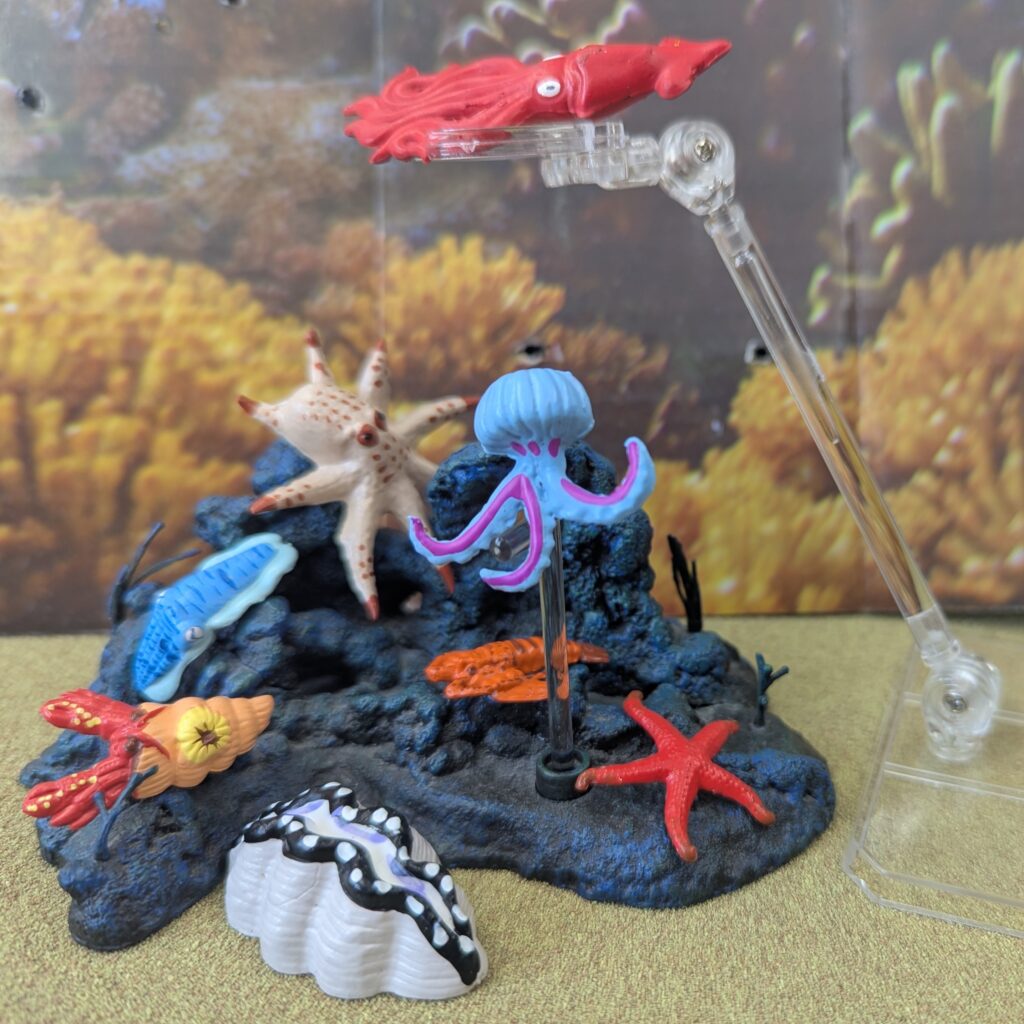
This time we’ll be seeing the entire ‘invertebrates’ made within the Panini mini sequence. That is most likely essentially the most taxonomically broad one, and likewise the biggest group. They’d even be among the many tougher ones to determine to species, however generally guesses will be made. On the upside, the small measurement makes them applicable for dioramas and equipment with typical figures. So long as the diorama doesn’t require excellent accuracy. As a observe, these have been the hardest to jot down the primary time…and I undoubtedly misplaced plenty of element with the rewrite. However I feel I could have tempered a few of my authentic opinions (which nonetheless aren’t excessive for a few of them).
A reminder for the units:
- Group One: Cetaceans (whales and dolphins) 6 species, 7 figures
- Group Two: Marine carnivorans (bears, weasels, and pinnipeds), penguin, and sea turtle 7 species
- Group Three: Invertebrates (starfish, jellyfish, mollusks, and arthropods) 8 species
- Group 4: Bony fish which might be most likely identifiable (pufferfish, clownfish, wrasse, grouper, butterflyfish, seahorse) 6 species
- Group 5: Bony fish which might be…much less identifiable (porcupinefish, eel, sabertooth fish, lyretail angelfish, and butterflyfish) 5 species
- Group Six: The ‘other fish’ Lamprey and Chondrichthyans (sharks and rays) 6 species
The figures:
Jellyfish (blue jellyfish?) Cyanea cf. lamarckii

First up we now have a jellyfish which is fairly clear from look, however very stylized. In some methods, it might signify the blue jellyfish Cyanea lamarckii, not simply because it’s blue however as a result of it’s sometimes Atlantic, which regularly provides inspiration to corporations like Panini. They’re discovered alongside the English Channel, north by Scandinavian waters. Massive people can have a bell as much as 20cm throughout, however are usually smaller additional north. As a species, they’re notable for 4 giant arms and a bluish color, lighter when younger however darker with age. They might even have purple highlights. The After all, they can be yellow. The determine is painted a lightweight blue total (so, in that respect, it’s actually a blue jellyfish) with purple highlights throughout the highest of the three giant arms, in addition to a hoop of purple dots beneath the bell.


For the sculpt, odd decisions have been made. For one, the arms/tentacles have been rendered flat, so the mannequin solely has three arms, and so they prolong from a central level beneath the bell, slightly than in a hoop. They’re sculpted to be virtually ‘frilly’ on the underside, which is a pleasant contact, however in any other case there are not any tentacles. The bell is a rounded half dome with folds sculpted in that stretch from the highest by the underside. It provides texture, however isn’t actually how a jellyfish bell ought to look. Essentially the most irritating a part of the determine is that there isn’t a cheap technique to make it stand upright by itself. It’s a small determine, about 1.5cm (0.6 inches) throughout the bell, giving a scale of 1:13 for an enormous particular person. There are different jellyfish figures and that is definitely one in all them, but it surely’s actually solely going to be good for backgrounds in shows; for collectors it is vitally inaccurate and I’m certain there are higher ones even at an analogous measurement.
Big clam Tridacna gigas

Subsequent, our first of a number of molluscs, a legend of journey tales, a large clam Tridacna gigas (most likely. There are different species, and this one is fairly generic). The determine is depicted as a half-shell, buried within the substrate, which is already a horrible alternative since we normally see them connected to the ocean ground at their umbo. Possibly plenty of sediment has constructed up? The color isn’t very large clam like, with the 2 valves painted a lightweight cream (making it look extra like a bleached, lifeless specimen), and the mantle border painted a really darkish purple with white spots. Trying between the open valves is a blob of fabric are a number of wavy lilac-coloured traces. General, it’s not an incredible illustration.


The sculpt can also be not an incredible depiction of a large clam. There are sulcus-folds within the two valves, with them sustaining a curve alongside the 2 margins, however they aren’t almost deep sufficient for a large clam. The physique can also be considerably extra compressed, as a substitute of the virtually globular form seen in a big, mature large clam. There’s some element alongside the outer shells, with a sequence of parallel ridges sculpted in. It goes with out saying that there are not any eyes alongside the margin, until that’s what the white dots are presupposed to be, however that may virtually make it worse. It’s arduous to find out scale for the determine provided that it’s sectioned. Assuming the size is the utmost diameter, it’s 4.1 cm (1.6 inches) throughout, giving a tough scale of 1:29. This determine is actually solely worthwhile for surroundings work, it barely registers as a good large clam determine however there usually are not plenty of decisions on the market…I feel the perfect recognized ones are all on the weblog, and the opposite two are much better.
Cuttlefish Sepia officianalis

This subsequent mollusc is sort of neat, a small cuttlefish Sepia officianalis. In all probability. Once more, fairly stylized so species alternative could differ. It has some attention-grabbing sculpt options a minimum of, and a few are good. Others are bizarre. The very first thing of observe is that the tentacle half and mantle half are about the identical size. The mantle is conical, with a fin surrounding it, barely extra flattened on the highest. On the apex of the sculpt there are two giant eyes protruding outward on bulging rings. The arms are prolonged ahead and down, compressed collectively as 4 distinct arms separated by sculpted grooves. There’s additionally a fin that extends out from the edges of the arms which could be very unusual, since that’s not a factor. At first I believed it was meant to point extra folded arms/tentacles, however no, it’s very flat, and clearly meant to be just like the physique fin. The underside is unsculpted.


The paint job is attention-grabbing. The general color is gentle blue, with a number of skinny, darkish blue dashes throughout the again of the mantle. The arms even have unbroken darkish blue traces throughout them. The eyes are white with skinny, angular black traces, most likely an try and signify the bizarre w-shaped pupil seen in a cuttlefish. The underside and surrounding fin are all the identical gentle blue color. As an apart, I’m unsure why the cuttlefish can be blue. They’ll change colour, however blue wouldn’t be typical. Oddly, the Bullyland cuttlefish fish from 20 years in the past can also be blue. I did say the determine is small, and I imply tiny. The mantle is 1.8cm (0.7 inches) lengthy, for a scale of about 1:11. This makes it excellent for a reef or different scene, however the determine itself is fairly small in any other case, and there are definitely extra spectacular cuttlefish figures out there.
Big Squid Architeuthis dux

Now, one other cephalopod, this time a large squid Architeuthis dux. And I’m simply going to say, I don’t prefer it. A lot mistaken about it. The sculpt is lengthy and flat, with a shortened physique and naturally lengthy arms and tentacles. General the physique proportions are bizarre. The arms and tentacles are compressed collectively, every sculpted to be curvy and distinct. The problem is that whereas there are the 2 bigger tentacles, with the widened membership on the tip, as there ought to be, however solely 4 arms as a substitute of the right 8 arms. Plus, as a substitute of rows of suckers, there’s a single row of bumps down every appendage. The location of the arms and tentacles additionally signifies that there isn’t a mouth to talk of. The distal finish of the physique has the arrow-shaped fins, flatter and prolonged out as properly. The eyes are on prime of the physique as a substitute of the edges, and sculpted as huge, flat discs. It’s apparent as a large squid, however being flat and lacking arms makes it so mistaken. Possibly the flatness is impressed by a washed-up on the seaside corpse?


The shortened physique could also be what provides the odd proportions. The mantle is about 2.1 cm (0.83 inches) lengthy, which supplies a scale of 1:107, so it’s fairly small. The color can also be sort of uninspiring. Everything of the physique is a flat, pale purple. No shading or any highlighting. The eyes are giant and white, with a tiny black centre. In order that they a minimum of make the eyes look appropriately giant, if very huge and unusual. The one different colour is a white spot on every bump/sucker. It seems to be unusual. However from above, in fact, none of that is seen so it’s only a purple squid. So total…I don’t advocate this determine. It’s not good sufficient, even at this measurement of determine there are numerous extra competent ones, and there are not any lack of large squid figures total. I don’t suppose it might even make a superb background determine in a scene (besides as an aforementioned corpse).
Widespread octopus Octopus vulgaris

The ultimate mollusc, and yet another cephalopod. This one’s clearly an octopus. It’s fairly tough to determine one thing like this to species, but it surely may very well be a typical octopus Octopus vulgaris. This might make sense given the huge distribution in lots of oceans all through the world, however notably within the Mediterranean, which makes it acquainted to Italy, dwelling firm of Panini! Octopuses are notable for his or her potential to alter color, however the frequent octopus is commonly gentle or darkish brownish with quite a lot of markings, so it might sort of match. The color on the determine is a lightweight cream color, with brown tips about the tip of every of the 8 arms. There are small, darkish spots alongside every of the arms, and a number of brown spots over a lot of the pinnacle and physique. The eyes are picked out as giant brown patches with black dots within the centre. The underside is totally white. So it may very well be a typical octopus, rendered within the broad model of Panini.


The sculpt is sort of chunky, however octopus-like. The top and mantle are bulbous, sculpted towards the rear-projecting legs. The eight arms are prolonged outward, unfold aside across the physique. There’s a slight tough texture on the higher floor pores and skin. It’s notable that the eyes are on slight projections, and behind these eye stalks are small horn-like projections (unsure if that could be a function of frequent octopus). The underside of the physique has a variety of pretty giant, round discs, most likely meant to signify suckers. That is good, however they’re far too giant, and much too few, to precisely signify and octopus’ arms. There’s not, nevertheless, and signal of a mouth or beak within the centre. The mantle is about 1.6cm (0.6 inches), which may very well be about 1:16 for a typical octopus, but it surely’s fairly subjective. It’s positive as a small octopus determine, it’s definitely completely different when it comes to colors. There are in fact plenty of octopus figures on this planet, that is definitely one in all them.
Hermit crab Paguroidea sp.

Now that we’re executed with molluscs, we’re transferring on the arthropods within the set, represented by a few crustaceans. This primary one is a hermit crab, superfamily Paguroidea, and there’s no cheap technique to attempt to determine it additional. Provided that the 2 units of claws seem straight out and comparable in measurement and form, possibly it’s a member of the household Pylochelidae, the ‘symmetrical hermit crabs’, however that may be an unbelievable stretch, and I doubt the Panini designers even had that sort of reference materials. As an alternative, it’s best regarded as ‘generic hermit crab’ based mostly on the sculpt of the forebody of a crab, which means the pair of flat plate of legs and barely bigger claws on both facet of the squished face, marked with a pair of antennae swept again over the shell. A small raised space on the entrance of the face signifies the mouth, and the eyes are on small raised bumps. The shell itself is given fairly a little bit of texture, though to me it seems to be extra like a (Cretaceous) rudist bivalve than a traditional gastropod because it opens on the one finish, as a substitute of in a whorl. Or a bizarre, hollowed coral. Once more, I doubt a lot effort was taken with reference supplies–extra of a ‘make a shell, still a crabby-part on the opening’.


When it comes to paint, it’s okay. As with a number of of those inverts, the general color is a vibrant purple. The eyes are painted as brown blobs, and there are a number of yellow spots on the claws. Unsure if there’s a hermit crab that has that function particularly, somebody on the market most likely is aware of higher than I do! The shell is a strong peach color, adorned with what seems to be a large yellow barnacle. Given the scale of the determine, that may very well be an enormous hermit crab. Or possibly it’s an anemone, folded in on itself for feeding. I recognize including some element, however unsure what that element is. Attempting to scale this determine is actually tough, however attempting to get a measurement throughout the pinnacle it’s about 0.6 cm (0.2 inches) throughout, which might give a scale of 1:3, or greater. Or decrease. This one is hard, and it actually would appear extra at dwelling as a background participant in a diorama or different scene. There are undoubtedly different hermit crab figures, most of that are most likely extra identifiable to a minimum of genus, and higher made.
European Spiny lobster Palinurus elephas

Subsequent crustacean is a spiny lobster, most definitely meant to be Palinurus elephas, once more principally due to the regional presence. However actually, it might most likely work for a lot of species (or genera) and environments–as at all times, Panini is fairly generic. The color doesn’t actually assist. The general color is an orangey-red, together with the underside. The physique is highlighted and decked out with darkish brown markings. This consists of the eyes, small spots on the antennae and carapace, darkish lateral bands over the segments of the stomach, and the complete telson and uropods. It’s really sort of good, if easy.


The sculpt will not be dangerous, if just a little flat. It sort of seems to be like a wall hanging or cooked animal. However plenty of particulars. The carapace is rounded with some roughened ridges. Towards the entrance are a pair bumps for the eyes. Simply previous the eyes are the massive antennae protruding ahead, then curving again over the legs, extending again additional. There are 4 pairs of legs prolonged laterally, sculpted to be pressed collectively as single followers. The highest of the stomach is sculpted as six ridge segments, terminating in a single rounded telson, with two fins on both facet to kind the uropods. The underside is extra flattened, with the tail fins, stomach, and legs sculpted individually however very shallowly. In some ways it’s really fairly good for a small spiny lobster determine, and at 2.6 cm (1 inch) lengthy, about 1:15, it suits pretty carefully to a variety of different marine animals. Nonetheless very stylized in fact, however possibly one of many higher invertebrate figures.
Seastar (Mediterranean purple sea star?) Echinaster cf. sepositus

And our final invertebrate determine, the one echinoderm, a sea star. Whereas I might most likely guess it’s a Mediterranean purple sea star Echinaster sepositus. However, actually, there are many sea star species that may very well be purple–if something, the situation of ‘Mediterranean’ can be my reasoning. As a result of the colouring isn’t significantly definitive–the dorsal floor is purple. Simply purple. Apart from the guidelines of the arms, that are tipped with a wash of brown. The underside, although, is extremely distinctive–the arms are decked out in white V-shaped chevrons. Positively distinctive, however I couldn’t discover any sea star species that has this sample on both facet. Very artistic.


It’s a small determine, about 3.2 cm (1.3 inches) throughout, for a scale of possibly 1:6 (though, once more, that would differ). The sculpt is unmistakable, with a raised central central physique and the 5 radiating arms. Every arm tapers to a slight curl on the tip, however every is formed otherwise. The arms are barely rounded on the higher floor, however the basic construct is sort of flattened. Over the complete prime floor the determine is sculpted with small ossicles; at this scale they’re most likely a lot bigger than they need to be, however a minimum of it’s some texture. The underside could be very easy, barely indented on the centre…so no signal of the tube arms, ossicles, or mouth components. General, a serviceable sea star determine however generic–nice for surroundings, however there are many choices on the market at this (and plenty of) sizes.

These are invertebrates from Panini. It’s a reasonably combined bag–some are a minimum of okay, some (large squid) are fairly poor (large squid). However most of the figures would function properly as extras or equipment in scenes or dioramas. A number of of them are most likely good for some collectors. Subsequent time, admittedly, I’m getting extra into my regular wheelhouse…it’s going to be plenty of fish from right here on out!